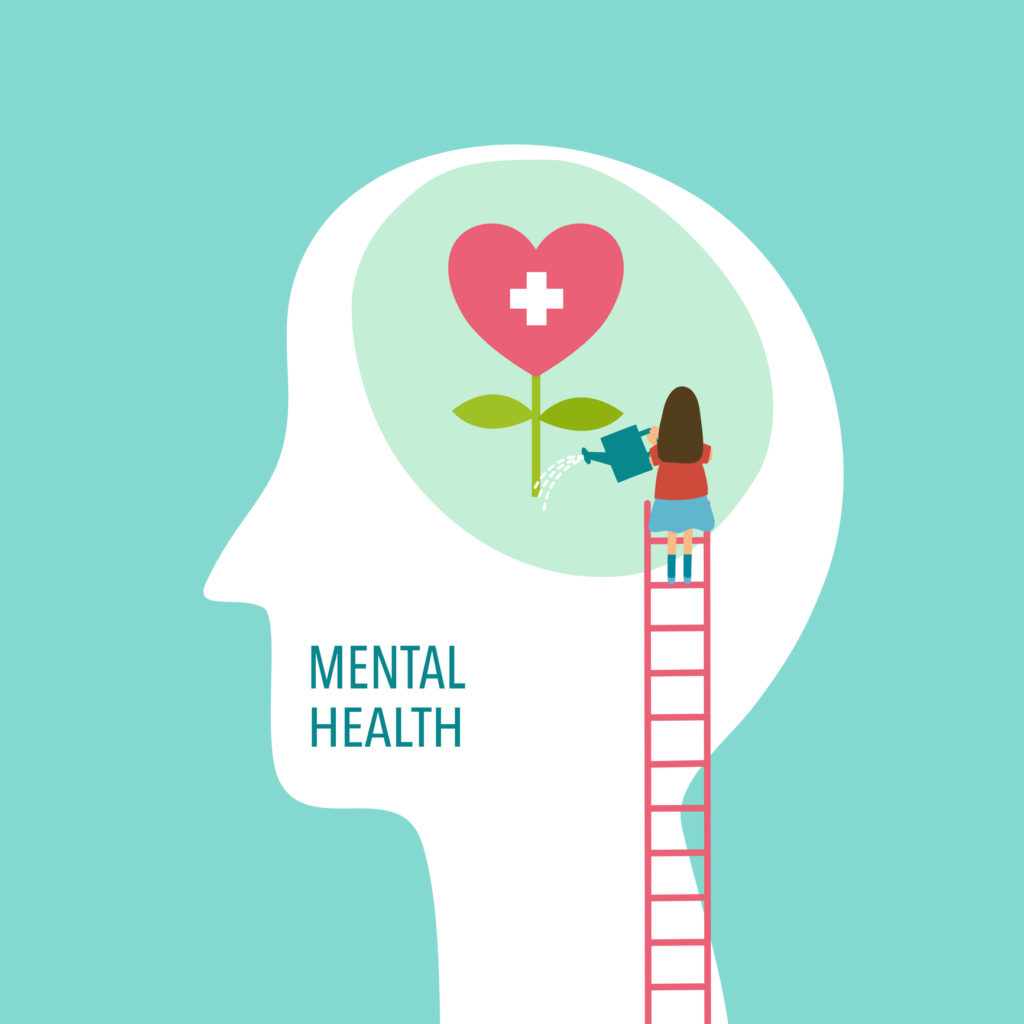
The term “mental health” is often used by many people, yet a lot do not fully understand how broad and wide a term it really is. Today, we take a look at some of the commonly asked questions, misconceptions, and myths surrounding mental health as well as best care options for different types of illnesses which fall under it.

WHAT IS MENTAL HEALTH?
W.H.O defines mental health as a state of ones’ well-being in which one realizes his/her own potential, can cope with the normal stresses of life, can work productively and fruitfully, and is able to make a contribution to his/her community.
In short, this is simply one’s emotional, psychological and social well-being.
The word, “mental” means relating to the brain, and “health” means a state of well-being.
Then, what is mental illness/disorder? Mental health illness is therefore defined as the incapacity to develop one’s own potential, manage with normal stresses of life, work efficiently, and/or meaningfully contribute to the community as a whole. Mental disorder, sometimes known as mental illness, refers to a spectrum of illnesses that impact mood, cognition, and behavior. This subsequently leads to major changes in thought, emotion/behavior, distress, and/or difficulties with family, work, or social activities.
BRAIN;
This is the coordinating center of sensation and intellectual and nervous activity.
It is responsible for the release of hormones such as dopamine, endorphin, adrenocorticotropic, growth hormone-releasing hormone, hypothalamic-pituitary hormone, melatonin, N-acetylserotonin,6-Hydroxymelatoninglucocorticoid cortisol, etc.
These hormones’ main function is protection and adaptation, but like any other system, an imbalance either in the positive or negative state causes a malfunction which in this case refers to the development of illness. Examples of illnesses that arise from such disorders are Parkinson’s disease, Schizophrenia, Bipolar (a.k.a Mania), Depression, etc.
As I mentioned above, “mental health” is a blanket cover, now let us take a look at what lies underneath this blanket.
TYPES OF MENTAL ILLNESS
For this post, I’ll divide these mental illness’s into 3 different groups:
- Most-common type
- Less-common type
- My big 3
- Most-common type:
- Anxiety disorders
This group of people responds to certain objects or situations with fear, panic, and/or physical signs (such as sweating, rapid increase in heartbeat, shaking). Diagnosis of this is usually done by introducing the person to a set of different situations then attentively analyzing the response if it is either appropriate or inappropriate, also observing if the person can/cannot control the response, and checking if it interferes with their normal functioning.
It subdivides into;
(i) generalized anxiety disorder
(ii) panic disorder
(iii) social anxiety disorder
(iv) specific phobias

- Mood disorders (affective disorders)
This involves unwavering feelings of sadness or feelings of being overly happy, followed by a sudden change from extreme happiness to extreme sadness.
Well-known mood disorders are;
(i) depression
(ii) bipolar disorder
(iii) cyclothymic disorder

- Eating disorders
Extreme emotions and attitudes involving weight and food, where the person either has an urge to overindulge in food or not to eat at all. The most common eating disorders are;
(i) anorexia nervosa
(ii) bulimia nervosa
(iii) binge eating disorder

- Impulse control and addiction disorder
Here, a person is unable to resist impulses to perform an act of either self-harm or one that harms another. Examples are pyromania (starting fires), kleptomania(stealing), excessive alcohol, drug addictions, and compulsive gambling. A person suffering from this tends to isolate themselves and ignores responsibilities.

- Personality disorders
People who suffer from this have inflexible personality traits which tend to be extreme. These traits can be distressing to both the person and his/her surroundings, causing problems at work, school, home, and/ social relationships. Examples of this include;
(i) antisocial personality disorder
(ii) obsessive-compulsive personality disorder
(iii) paranoid personality disorder

- Obsessive-compulsive disorder (OCD)
The obsessive part refers to the lingering, disturbing thoughts whereas the compulsive part refers to the routines/rituals. These individuals are tormented by lingering thoughts or fear causing them to behave or indulge in everyday routines/rituals which must not be side-tracked.

- Post-traumatic stress disorder (PTSD)
This usually develops after a terrifying/horrific event such as sexual assault, physical distress, war, death. People with PTSD tend to be emotionally numb.

2. Less-common types:
- Schizophrenia
This is a chronic and severe disorder. It affects how a person thinks, feels, and behaves. It is caused by an increase in the production of dopamine. Symptoms are classified into positive and negative.
(i) Positive symptoms;
-delusions
-hallucinations
-agitated body movements
(ii) Negative symptoms;
-reduced speaking
-reduced expression of emotions via facial expression and/ voice tone
/what-are-the-symptoms-of-schizophrenia-2953120-cba74c5e1dd942ecafde1824217603f9.png)
- Tic disorder
These people display repeated, quick, sudden, uncontrollable body movements or sound production which is involuntary. Tourette’s syndrome is an example.

- Factitious disorders
Here, a person intentionally complains of either physical/emotional symptoms in order to receive attention as either a patient or as a person in need.

3. My big 2:
This group for me has the most interesting types of mental illnesses as these have been causing quite a stir, with people trying to find out and manufacture specific medications will which target their exact causatives. If you are well-read and have been following and taking note of what I have written above, you’ll most likely by now know what my big 2 are, without further ado, I introduce you to:
- Parkinson’s Disease
- Alzheimer’s Disease
- Parkinson’s Disease (PD):
This is a chronic and progressive movement disorder, meaning that with time the symptoms continue to worsen. The cause is still unknown, and as of right now there is no present cure, but medication and surgery serve as treatment options. Neurons (nerve cells in the brain) malfunction and die. These neurons are found in a region of the brain known as substantia nigra (black surface) and are responsible for the production of dopamine, which I mentioned earlier on as one of the key hormones produced by the brain. Dopamine sends messages to the part of the brain that controls movement and coordination. With Parkinson’s, there is a decrease in the production level of this hormone and the person is unable to control movement.
For people suffering from Parkinson’s disease, symptoms vary from one person to the other but the key primary motor signs are;
- rigidity or stiffness of the limbs
- uncontrollable shaking of the hands, arms, legs, face
- slowness of movement known as bradykinesia
- impaired balance and coordination

2. Alzheimer’s Disease (AD):
AD is a chronic neurodegenerative disease which like PD continues to worsen over time. The death of brain cells causes memory loss and cognitive decline. It is the causative of greater percentages of Dementia cases. There is still debate as to what causes this degenerative disease, according to Wikipedia, 70% of the cause is genetic, and the other 30% is divided between are a long list of factors which include a history of head injuries, depression, hypertension, etc.
Amyloid-beta which is a protein found in the brain forms plaques which tangle in the brain, causing a disintegration of another protein called tau, thereby distorting the normal everyday/daily function of the brain.
Symptoms can be diagnosed at any stage and after initial diagnosis, progression is monitored, this then dictates how care is managed.
NB: symptoms are often mistaken for old age.
(i) loss in memory
(ii) decrease in their ability to take in new information
(iii) impaired visuospatial abilities
(iv) speech, reading, writing impairment
(v) changes in behavior and personality

AD has different stages depending on the progression;
1) preclinical (which presents no symptoms)
2. mild cognitive impairment
3. dementia
Risk factors associated with AD are;
(i) age (more likely in older people over 65 yrs)
(ii) family history (inheritance of causative genes)
(iii) presence of the apolipoprotein E (APOE) gene, puts the carrier at a 3-8 times more risk than a person without the gene.
NB: There is no known cure as the death of brain cells cannot be paused or reversed. However, the following care options have proved effective by reducing symptoms and improving quality of life;
(i) adult day-care
(ii) in-home care
(iii) residential care
(iv) hospice care
(v) respite care, help improve quality of life for both the elders and their families.
(vi) availability of medication.
FOR ALL THE DIFFERENT MENTAL HEALTH ILLNESSES I HAVE MENTIONED, IT IS IMPORTANT TO KNOW AND TO UNDERSTAND THAT, NO ONE-SIZE-FITS–ALL FORMULA WORKS.
The type of care needs to change at different stages of the disease and each family situation is unique.
HOW TO TAKE CARE OF MENTAL HEALTH PATIENTS:
A well-known Physician once said,” The best medicine for humans is love, if at first it doesn’t work, don’t worry, increase the dose”
Although taking care of mental health patients presents unique challenges as the problems vary greatly in severity and causes, the major qualities required from a caregiver are LOVE, PATIENCE, UNDERSTANDING, and the ability to COMMUNICATE.
- Give the person you care for enough time to make themselves heard, it is very important to listen to what they have to say. Allow them to express themselves without interrupting, or offering your own personal option. Always encourage and reassure them when they appear to be struggling, be it with movement, emotion etc.
- Always make sure you follow the prescribed medication routine and be sure to give it at the specific mentioned times.
- Do not discriminate or treat them differently from the next person.
- Develop a trusting bond between you and them, this will them settle down more and warm up to you which in return results in progress health-wise.
- Do not forget to celebrate special events with them, be it wedding anniversaries, birthdays, Christmas, thanksgiving, valentine’s day etc, just to show you care.
- Finally, above all else, LOVE THEM, love has proven to be the best medicine as it heals what lies beyond the naked eye, it heals the SOUL.
I hope you enjoyed reading this just as much as I enjoyed writing it.
My parting words are from the bible, John 13 verses 34-35; “A new command I give you: Love one another. As I have loved you, so you must love one another. By this everyone will know that you are my disciples if you love one another.”

Leave a Reply