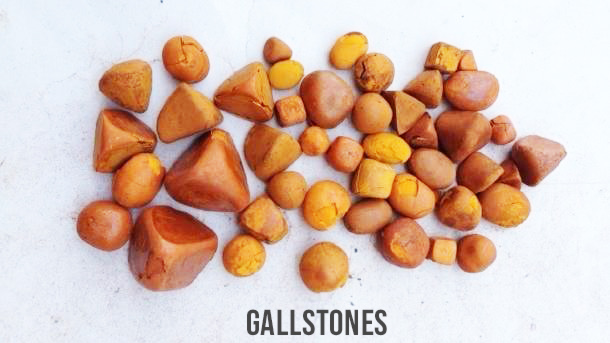
GALLSTONES (CHOLELITHIASIS)

Home Health GALLSTONES (CHOLELITHIASIS)
GALLSTONES (CHOLELITHIASIS)

Cholelithiasis refers to the presence of abnormal concentrations (gallstones) in the gallbladder. They mostly consist of cholesterol but sometimes they may be pigmented due to hemolysis (a condition characterized by the excess breakdown of Red Blood Cells (RBCs)), infection, or mixed (hemolysis and infection).

Gallbladder Removal Surgery in Chennai | Gallstones Treatment

Unfortunately for us women and fortunately for you Sons of Adam, gallstones are more common in females than in males with a ratio of 2-3:1. The peak incidence of the disease is approximately 40 years of age and about 10-20% of the adult population in developed countries has this disease.

I know by now you are wondering, what on earth causes these stones or where do they come from. Well, wonder no more.

Generally, an imbalance in bile salts, cholesterol, calcium carbonate, and bilirubin cause cholelithiasis. The key component in gallstone formation is biliary stasis. Bile stasis is caused by impaired gallbladder emptying. This can be due to several things such as bowel rest, this then leads to sludge in the biliary therefore causing bile stasis.

There are three types of gallstones (GS); (i) cholesterol GS, (ii) mixed GS, (iii) black pigment GS.

(i) About 95% of all gallstones are due to cholesterol and are thus called Cholesterol stones.

Risk factors for these are:

Obesity

Age > 40 years of age

Family history

Malabsorption

European, Native American, or Hispanic ancestry

Drugs (fibrates)

Rapid weight loss

Link of obesity and gallstones formation risk - MedCrave online

(ii) Less than 10% of all stones are termed Black pigment stones. These are radiopaque stones made of calcium bilirubinate.

Risk factors for development include:

Hemolysis (chronic hemolytic anemias such as sickle cell disease)

Crohn disease

Alcoholic cirrhosis

Advanced age

(iii) In some cases, there can be mixed/ brown pigment stones (radiolucent gallstone composed of calcium salts of unconjugated bilirubin and a small amount of cholesterol). Here, the risk factors are:

bacterial infections and parasites in the biliary tract.

Clinically, most gallstones are asymptomatic.

When symptomatic, symptoms present as:

  1. Biliary colic: constant, dull Right Upper Quadrant (RUQ) pain lasting less than 6 hours. This pain may radiate to the epigastrium, right shoulder, and back.
  2. Nausea, vomiting, early satiety
  3. Bloating, dyspepsia (epigastric pain that lasts longer than 1 month)
Symptoms of cholecystitis

When it comes to diagnostics, asymptomatic cholelithiasis has no diagnostic workup required.

In suspected symptomatic cholelithiasis we do the following imaging tests:

  • Abdominal x-ray
  • RUQ ultrasound (best initial test)
  • Magnetic resonance cholangiopancreatography (MRCP). Second-line test if ultrasound findings are inconclusive.
  • CT abdomen with IV contrast. Used if ultrasound is inconclusive and MRCP isn’t available.
gallstones diagnosis

Blood samples will be collected and taken for laboratory studies. Typically, these will be normal in uncomplicated cholelithiasis, but it is essential to do these tests so as to rule out other acute biliary conditions and/ or other causes of acute abdominal pain.

  • CBC; usually normal
  • LFTs; usually normal
  • Amylase, lipase; usually normal

Treatment approach for all patients must:

  1. Provide supportive care
  2. Identify and treat concurrent choledocholithiasis (gallstones in the common bile duct)

Initial supportive therapy focuses on symptomatic treatment.

  • For bowel rest, NPO, (nil per os). This means nothing should be taken by mouth (e.g., medications, food).
  • Biliary colic: NSAIDs such as Ketorolac, Diclofenac, and Ibuprofen are the preferred first-line analgesics. For severe pain that doesn’t improve with NSAIDs, the use of opioids such as Morphine, Buprenorphine, and Meperidine is recommended.
  • In patients with protracted vomiting, IV fluid therapy, antiemetics and insertion of nasogastric tube with suction is recommended.

Asymptomatic cholelithiasis:

Expectant management works better. This means having regular clinical monitoring for symptoms of the disease. In patients with a high risk of developing gallbladder cancer or complications, considering an elective cholecystectomy (removal of the gallbladder) will be wise.

Symptomatic uncomplicated cholelithiasis:

The mainstay of treatment is elective cholecystectomy. In cases where surgery is not possible, then consider conservative management with oral bile acid dissolution therapy and/or extracorporeal shockwave lithotripsy.

Symptomatic complicated cholelithiasis:

Empiric antibiotic therapy and cholecystectomy are the mainstays of treatment but only after initial supportive therapy.

Figure 1

That is all for now. Remember to go for frequent checkups if you are a male above the age of 40 and/or with a family history of cholelithiasis.

Stay safe and see you soon!

Leave a Reply

Your email address will not be published.