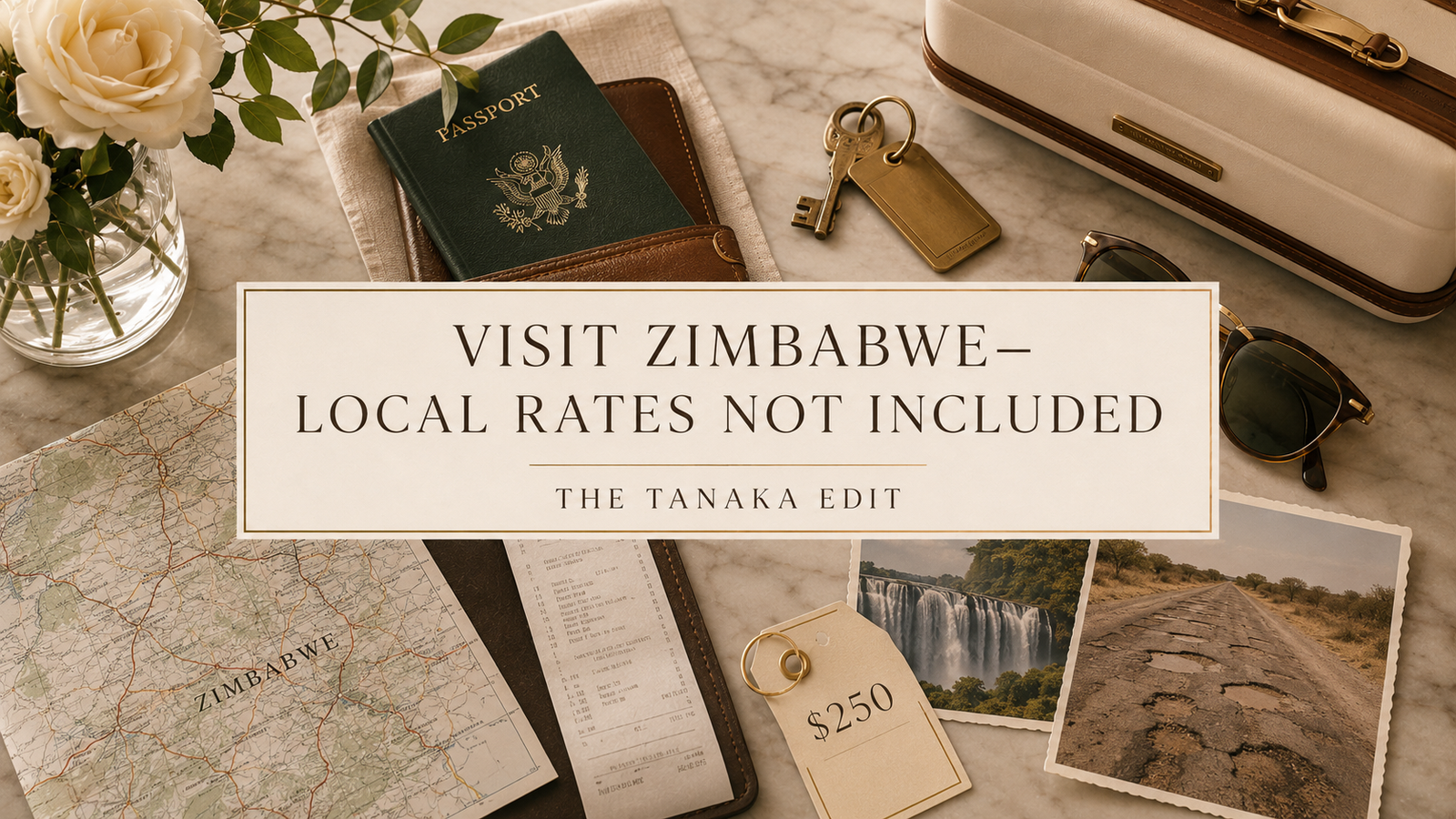
Three holiday plans, one bank balance and no Victoria Falls.

Dan and I were both in Zimbabwe, and I wanted to show him just how beautiful my home country is.
As a proud Zimbabwean married to a Cameroonian man, this was not merely tourism. It was diplomacy. It was national service. It was my chance to establish, once and for all, that although Cameroon may beat us in football, when it comes to scenery, y’all do not even compare.
I said what I said.
Zimbabwe has Victoria Falls, one of the world’s seven natural wonders. Cameroon does not. Those are simply the facts, your honour.

So I thought, Let me take my husband to Victoria Falls. Romantic, patriotic and educational. What could possibly go wrong?
Yes, Sally, I know: my husband this, my husband that. I would have told you to clock it, but apparently that phrase has been linked to the occult, and this Baddie for Christ, me incase you were wondering who i was referring to, is not about to upset her biggest Blesser. Daddy Lord Jesus: the One who was, who is and will be. Now let the church say Amen extra loudly for the people at the back!
And that is on I do not play about my Yahweh.
Anyway, back to my campaign for the Best Wife Award, and the holiday plan that was about to test both my faith and my bank balance.
Then I opened Momondo.
I searched for return flights from Harare to Victoria Falls for the two of us.
Nearly US$700.
For a domestic flight.
To remain inside the same borders.
I did not close the app. The app closed me.

For context, fares change with dates and availability, but current comparison sites commonly place a single Harare–Victoria Falls return ticket around US$370 to US$440. For two people, that can easily become US$740 to US$880. At the same time, South African Airways has advertised Harare–Johannesburg return fares from about US$249 per person. In other words, Dan and I could potentially fly to another country and still have money left towards accommodation.
Make it make sense.

The potholes were deep, but the prices were deeper
Now, because I am a woman of solutions, I moved to Option B: road trip.
We would drive from Harare to Victoria Falls. We could make a whole adventure out of it, see Hwange and whatever else lies between Harare and Vic Falls.
You will have to excuse the vagueness. When it comes to geography, I am Legally Blonde.

See what I did there?
Anyway, back to the road trip.
Option B was also a firm NO. The road to Victoria Falls was so terrible that some of the potholes looked approximately two centimetres away from hell’s door. I mean, hell hath no fury like a woman scorned, but I had not been scorned, my good sir, so there was absolutely no reason for me to go knocking on hell’s door. We might have left Harare in one piece, but let us face it: there was no guarantee we would return in the same format.

Fine. Victoria Falls cancelled.
Enter the ancestors
We moved to Option C: the Eastern Highlands.

Troutbeck, perhaps? Or Mountain Lakes Resort in Juliasdale? I had heard about the newer resort and thought it looked beautiful.
Besides, I am from the Eastern Highlands. I could drive there blindfolded.
I am joking. Please do not put me up to this.
I immediately searched the rates, and my ancestors said, “Who had you discussed this with?” 😂

Okay, okay, okay. Surely we could find something else.
Mbuya Nehanda and Sekuru Kaguvi looked at the bank-account balance and said, “No, our child. Not with that.”
At that point, Dan and I began looking beyond Zimbabwe. And please explain to me why flying to another country started looking more affordable than touring our own.
That was when the joke stopped being funny.

So, when you see Dan, please do not ask him which Zimbabwean attraction he enjoyed most. The places he visited most were Harare restaurants. If we are allowed to add those to his travel résumé, then my husband is practically a certified Zimbabwean gastronome, or, at the very least, Harare’s unofficial food-tourism ambassador.

He may not have seen Hwange, Kariba or Great Zimbabwe, but he can probably tell you where to find a good steak in Harare. Apparently, that is the Zimbabwean tour package my bank account approved.
The embarrassing part
Somewhere between cancelling Victoria Falls, abandoning Nyanga and promoting Dan to Harare’s unofficial food-tourism ambassador, I realised something slightly embarrassing: I have visited more than fifteen countries, yet I have barely seen my own.

There is a question travellers love asking each other: How many countries have you been to?
It is usually followed by a small, socially acceptable performance of pretending not to count, before giving the exact number you absolutely counted.
Mine is more than fifteen.
I have crossed borders, navigated unfamiliar airports, learnt the choreography of immigration queues and mastered the fine art of fitting an unreasonable number of outfits into one or maybe two suitcases. I can talk about places beyond Zimbabwe with the confidence of someone who has been there, eaten there and probably taken far too many photographs there.
But ask me how much of Zimbabwe I have seen, and suddenly the résumé becomes very short.

Victoria Falls? Yes; as a child, courtesy of my parents’ pockets, and later for the infamous Vic Falls Carnival.
Nyanga? Of course. I mean, I’m Ndau, the Eastern Highlands are practically in my DNA.
Kariba? No.
Hwange? Not yet.
Masvingo and Great Zimbabwe? Embarrassingly, no.
Bulawayo? Also no.
And before anyone revokes my Zimbabwean citizenship in the comments, let me explain.

Home has always been home—not a holiday
When you live somewhere, it is easy to treat it as the background to your life rather than a destination worthy of discovery.
Zimbabwe is where I am from, its where I work, run errands, sit in traffic, attend weddings, answer emails and complain about the price of fuel. It is home. And home, by its very nature, often feels as though it will always be there.
Kariba can wait.
Hwange is not going anywhere.
Great Zimbabwe has survived for centuries.

Meanwhile, an international trip feels urgent. There is a visa validity date, a flight deal, a wedding, an invitation or the thrilling possibility of waking up somewhere that does not recognise your usual routine. We save for it, plan for it and give it a proper place on the calendar.
Domestic travel is often relegated to “one day.” Then one day comes, you search the prices, and “one day” politely returns to the future.
By the time I added local transport, the room, fuel, meals, park fees and activities, an international holiday could offer more nights, more inclusions and more perceived value for the same money, or not much more.
To be fair, an overseas holiday is not automatically cheaper. Airfare can destroy that argument before it has even cleared immigration. International travel also brings visas, transfers, insurance and the kind of airport spending that makes a sandwich feel like a luxury purchase.
But travellers do not judge cost in isolation. We judge value.

If a local two-night stay begins competing with a longer trip elsewhere, particularly when the international option includes breakfast, reliable transport, a wider range of accommodation and more activities, the question becomes unavoidable:
Why does discovering home sometimes feel like the luxury option?

Number one in the world—but can the locals come too?
In 2025, Zimbabwe topped a Forbes list of the world’s best countries to visit, based on travel-expert input and insights from KAYAK. (Forbes)
And honestly? I love that for us.

I love seeing Zimbabwe celebrated for what we have always known it possesses: breathtaking landscapes, remarkable wildlife, deep history and the kind of natural beauty that does not need a filter.
But hello, can the locals have local rates?
Being Zimbabwean is already enough of a headache. We have endured inflation, currency plot twists and bank balances that change personality depending on which exchange rate has entered the group chat. Surely one small reward for citizenship could be the ability to experience our own country without first consulting a financial adviser and three generations of ancestors.

Celebrate the international tourists. Welcome them warmly. Charge for the premium experiences they came to enjoy.
But please, leave a local rate at reception for the rest of us.
This is not a demand for five-star travel at two-star prices
Let me say this before the tourism economists enter the chat: I understand that hotels are businesses, not charitable organisations with infinity pools.

Beautiful properties cost money to build and maintain. Safari operations have vehicles, guides, conservation costs, licences and staff to pay. Remote lodges must transport food, fuel and supplies over long distances. Power, water and infrastructure challenges increase operating costs. Quality hospitality should be profitable, and the people who create these experiences deserve to earn a living.
This is not an argument that luxury should be cheap.

It is an argument that Zimbabwean tourism needs more rungs on the ladder.
There should be something between staying home and booking the honeymoon suite. More clean, safe, well-designed mid-range accommodation. More resident packages that are genuinely attractive, not merely a small discount on a rate already beyond reach. More family bundles, off-season offers, instalment options and experiences that allow locals to enjoy the destination without purchasing every part of it separately.
Because “affordable” does not have to mean poorly maintained, and “local” should not be treated as another word for “low value.”

A country marketed to everyone except its own people
Zimbabwe is not short of things to see.
We have one of the Seven Natural Wonders of the World. We have wildlife, mountains, ancient architecture, lakes, waterfalls, forests, rock formations and cities with histories that deserve more than a hurried school lesson. We have places international travellers cross oceans to experience.
Yet many Zimbabweans know them mainly through tourism adverts, school textbooks and other people’s Instagram pages.

There is something unsettling about living beside extraordinary beauty and experiencing it as a spectator.
Much of our premium tourism product understandably targets international visitors, whose foreign-currency spending is vital to the industry. But when the price is designed around the international tourist, the Zimbabwean resident can begin to feel like an outsider in their own country.
The result is an odd kind of tourism inequality: we are close enough to recommend the destination, but not always financially close enough to experience it.
We become unpaid ambassadors for places we have never been.
“You must visit Kariba,” we say confidently.
Based on what, exactly? Vibes? A Grade Four geography lesson? Our cousin’s WhatsApp status?

The problem is bigger than one expensive hotel
It would be easy to blame resorts alone, but the cost of domestic tourism is an ecosystem.
Zimbabwe’s own tourism development research has acknowledged that reaching destinations such as Kariba, Hwange, Mana Pools and the Eastern Highlands can be difficult and expensive. The country’s limited domestic air connectivity means that many trips depend on long road journeys, and those journeys come with fuel, vehicle wear, road conditions and time. The same research describes domestic travel as a market with significant room to grow and identifies price and public services among the barriers affecting tourism. (Zimbabwe Tourism Authority destination analysis)

More recently, the Zimbabwe Tourism Authority has spoken publicly about improving affordability while encouraging more Zimbabweans to explore local destinations. (The Herald) That acknowledgement matters, because it confirms that this conversation is not simply a group of locals being dramatic on social media. Affordability and access are real policy questions.
The dream of domestic tourism cannot rest on beautiful marketing alone. A cinematic video of Kariba will inspire me, yes—but it will not drive me there, feed me or reduce the room rate.
We cannot hashtag our way out of the maths.

What we lose when locals cannot travel
Domestic tourism is often discussed as an economic opportunity, and it is. Local travellers keep money circulating within the country, support jobs and help businesses survive between international peak seasons.
But something less measurable is also at stake.
Travel creates belonging.

It is one thing to know that Great Zimbabwe exists. It is another to stand before it and understand that African ingenuity did not begin when someone else arrived to document it.
It is one thing to see elephants on a screen. It is another to watch them move through Hwange and realise that conservation is not an abstract international cause; it is part of your inheritance.
It is one thing to point at Kariba on a map. It is another to watch the sun settle over the lake and feel, without needing to explain it, that this is yours too.
When citizens cannot access their country’s cultural and natural treasures, we lose more than tourism revenue. We lose familiarity. We lose pride built from experience rather than slogans. We risk raising generations who can name attractions abroad more easily than places a few hours from home.
I am already evidence of that contradiction.

Perhaps I am part of the problem too
As tempting as it would be to blame the entire situation on room rates and conclude with righteous indignation, honesty requires more.
I have also postponed Zimbabwe.

I have treated international travel as an event and local travel as something I could organise later. I have searched premium resorts, felt offended by the prices and sometimes failed to look beyond the first page for smaller lodges, community-run experiences, self-catering options or group trips.
The tourism industry needs to make Zimbabwe more accessible to Zimbabweans, but Zimbabweans, myself included, may also need to become more intentional about discovering home.
Both things can be true.

I can call for better value while admitting that exploration requires effort. I can question pricing without pretending every operator is greedy. I can acknowledge the real cost of providing quality tourism while asking why the local market so often feels like an afterthought.
Nuance may not trend, but it usually tells the truth.

I still want to meet my country
This is not a breakup letter to Zimbabwean tourism. It is, perhaps, a letter from someone who has loved her country mostly from a distance and would now like a proper introduction.
I want to see Kariba beyond photographs of houseboats and sunsets.
I want to experience Hwange without narrating it as though I have already been.
I want to walk through Great Zimbabwe and feel the weight of a history that belongs to us.

I want to know Bulawayo as more than a name attached to relatives, factories, history and exceptionally wide roads.
I want my future travel stories to include more of home, not as a consolation prize when an international trip is impossible, but as a destination chosen with excitement.
Zimbabwe does not need to convince me that it is beautiful. I already know that.
What it must help convince me and thousands of other Zimbabweans is that its beauty is also for us.

Until local rates become a little more pocket-friendly, you’ll find me catching flights, not feelings,(well I already caught those), and certainly not drowning in potholes on my way to a holiday I can barely afford. Zimbabwe, I love you deeply, but for now, I may have to admire you from the departure lounge.

Is domestic travel equally expensive in your country of birth or permanent residence? Share your experience in the comments below, I’d love to know whether locals elsewhere face the same struggle.
Until next time, Alexa, play Take Me Home, Country Roads, although considering the state of the roads, perhaps just play The Climb by Miley Cyrus. These local holiday prices are clearly an uphill battle.

Leave a comment