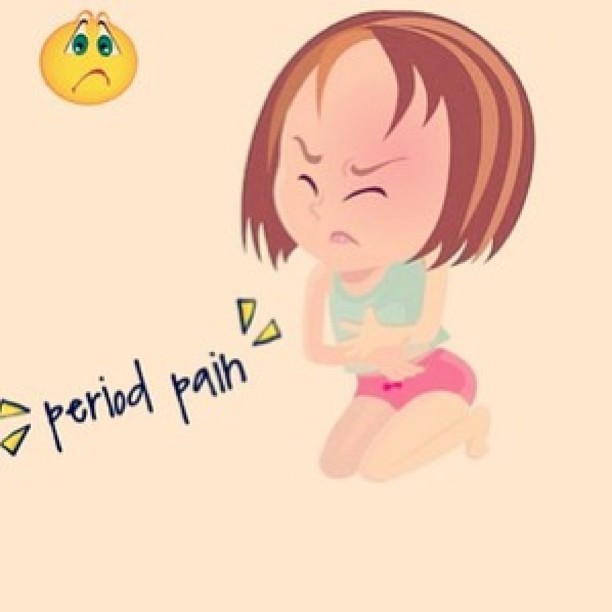
Dysmenorrhea commonly known as period pain or menstrual cramps or jeko in my language (Shona) is recurrent lower abdominal pain associated with menstruation.

Up to 90% of women who menstruate experience dysmenorrhea for 1 to 2 days each month. Usually, the pain is mild. But for some women, the pain is so severe that it keeps them from doing their normal activities for several days a month.
My mother also used to narrate to my sisters (Rachel and Hazel) how crippling her dysmenorrhea was. Back when she was in high school, the teachers already knew that once every month Carol will be absent from classes for a certain period of time because for her, Aunt Flo, meant excruciating pain that radiated from her back to her knees, loss of appetite and vomiting after each eating attempt.
Obviously, since most of our parents have these stories, they like adding salt and sugar so as to entice us, we never really believed her till fury came knocking at our own doors.

Symptoms are similar to those of PMS with a few differences such as:
- In Dysmenorrhea, the pain is spasmodic, crampy and often radiates from the lower abdomen / pelvic midline to the back, thighs or knees.
- There is flushing, which is the reddening of the face and neck caused by vasodilation of small arteries and arterioles.

Unknown to most women, there are actually 3 types of Dysmenorrhea:
i.Spasmodic / Primary:
Primary dysmenorrhea is the cramping pain that comes before or during a period. This pain is caused by natural chemicals called prostaglandins that are made in the lining of the uterus. Prostaglandins cause the muscles and blood vessels of the uterus to contract. On the first day of a period, the level of prostaglandins is high. As bleeding continues and the lining of the uterus is shed, the level goes down. This is why pain tends to lessen after the first few days of a period.
ii. Secondary:
Secondary dysmenorrhea is caused by a disorder in the reproductive organs (underlying condition) e.g., some definite lesion. This type commonly affects female individuals over the age of 25.
The common causes are:
a) Infection: Pelvic peritonitis, Salpingo-oophoritis, Parametritis, Cervicitis.
Salpingo-oophoritis (inflammation of a fallopian tube and an ovary) gives rise to irregular, tender swellings on either side and behind the uterus. Swelling will be fixed and there will be one or more attacks of acute illness with pelvic pain.
Small hemorrhage and hemorrhagic cyst of the ovary in which the contents are chocolate-like also play an important role in this type of dysmenorrhea.
b) Uterine causes: Intrauterine device (IUD), Adenomyosis, Fibroids, Cervical polyps, Pelvic Inflammatory Disease (PID)
Adenomyosis (a condition in which the lining of the uterus (endometrium) breaks through the muscle wall of the uterus (the myometrium)) may produce general enlargement of the uterus.
c) Extrauterine causes: Endometriosis, Adhesions, Functional ovarian cysts, Inflammatory bowel disease.
The pain tends to get worse over time and it often lasts longer than normal menstrual cramps. For example, the pain may begin a few days before a period starts. The pain may get worse as the period continues and may not go away after it ends.
iii) Membraneous:
In this, pain is aching and continuous first then becomes colicky and spasmodic when the uterus is trying to expel the characteristic membrane or cast and being finally relieved when it comes out.
Now that we are all up-to-speed with the different types of Dysmenorrhea, it’s time we learn how it is diagnosed.
- A pelvic ultrasound exam may be done when pain is not relieved with medications.
- In some cases, an ob-gyn may recommend a laparoscopy. This is a procedure that lets an ob-gyn view the organs in the pelvis. With laparoscopy, a small incision (cut) is made near the belly button. A thin, lighted camera—a laparoscope—is inserted into the abdomen. Laparoscopy often is done with general anesthesia in a surgery center or hospital.
- Complete blood count with differential so as to rule out infection.
- Urinalysis (rules out urinary tract infections)
- Measure human chronic gonadotropin (rules out ectopic pregnancy)
- Gonococcal/chlamydial swabs (rule out sexually transmitted diseases and pelvic inflammatory disease).
At this point, we now know the different types, how to diagnose the only thing left for me to talk about is the treatment.
For the Spasmodic/ Primary type (the one I used to have), my dad Dr. M Mhlanga who is a consultant ob-gyn gave me the miracle drug as me and my sisters call it, Mefenamic Acid tablets. These coupled with:
- Diclofenac/ibuprofen
- Exercise
- Green tea
- Hot water bottle
- Keeping warm
- Prayer (I know most people say this but I actually mean it) did the trick for me. Now I barely feel any pain and I enjoy visits from Aunt Flo as they are now pain-free.
Some people do however swear by:
- Ginger tea
- Aloe vera juice
- Cinnamon
- Lavender oil
- Feminax express 342mg
- Contraceptive pill
- Sex

The treatment for the Secondary type depends on the underlying cause.
That is all for now. I hope I managed to shed some light on Aunt Flo, her monthly reminder, and her fury that scorns most of us.

Feel free to ask any questions and leave some feedback down below.
See you all next week!

Leave a Reply